
The holidays are supposed to be the happiest time of the year. But what if you’re feeling flat, tearful, or worn out while everyone else seems to be having a great time? It's easy to wonder what's wrong with you.
Here’s the answer: Nothing is wrong with you. Feeling low during the holidays is common, and it has plenty of causes. That being said, there's a real difference between a rough season and clinical depression. And knowing which one you're dealing with helps you get the right kind of help.
Why the holidays can feel so heavy
The season piles a lot on at once. There's the shopping, the hosting, the budget, and the family dynamics, plus the pressure to feel joyful on cue. For many people it also brings grief, because the holidays put a spotlight on who is missing from the table. Loneliness, a packed schedule, disrupted sleep, and extra alcohol can all pull your mood down too.
For many women, much of the emotional and logistical load often lands on one set of shoulders. If you're the person who makes the holidays happen for everyone else, it's no surprise when you run out of steam.
What the holiday blues look like
The holiday blues are a response to a situation. They're usually:
- Tied to specific stressors, like a family gathering, a financial squeeze, or a memory
- Short-lived, easing as the season ends and routines return
- Milder, so you can still get through your day and enjoy moments along the way
You might feel tired, tense, wistful, or a little down. Rest, time with people who feel safe, a walk outside, and permission to say no to a few things often help.
What clinical depression looks like
Depression is a medical condition, not a mood you can talk yourself out of. It's more intense and lasts longer, and it doesn't switch off when the stressor passes. Signs include:
- Sadness, emptiness, or numbness that lasts most of the day, nearly every day, for two weeks or more
- Losing interest in things you used to enjoy
- Changes in sleep or appetite
- Trouble concentrating or making decisions
- Feeling hopeless, worthless, or excessively guilty
- Pulling away from the people you love
- Thoughts of harming yourself or that life isn't worth living
The clearest dividing line is how much it affects your life. With the blues, you feel off but you keep going. With depression, work, relationships, sleep, and basic daily tasks start to suffer.
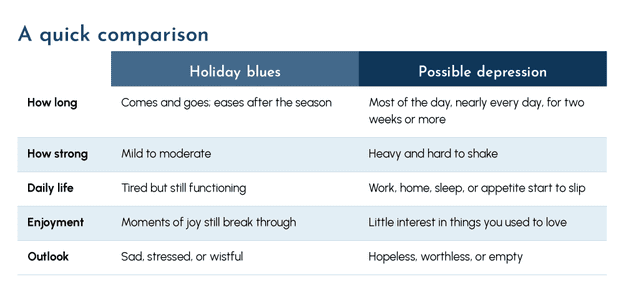
Depression can also overlap with other conditions, and seasonal affective disorder, a type of depression that follows the seasons, can make winter harder. A professional can help sort out which is which.
When to reach out
Consider talking to a doctor or mental health professional if:
- Your low mood lasts two weeks or more, or continues after the holidays
- It's interfering with work, relationships, sleep, or eating
- You're using alcohol or other substances to cope
- You feel hopeless or like a burden to others
If you have thoughts of harming yourself, don't wait. Call or text 988 right away, any time of day. Veterans and their loved ones can call 988 and press 1, or text 838255, to reach the Veterans Crisis Line.
The holidays can be harder for veterans and military families
VA mental health experts note that the holidays can intensify loneliness, grief, and memories of service, and that many veterans feel pressure to look fine when they're struggling. If that sounds familiar, know that reaching out is a sign of strength. BrainCare Performance Center Carlsbad, a veteran-owned clinic, is proud to serve our military community.
If it's depression, it is treatable
Many people improve with talk therapy, medication, or both. If you've tried those and still haven't found enough relief, there are other options. Transcranial magnetic stimulation (TMS) is an FDA-cleared, non-invasive treatment for major depressive disorder. It uses gentle magnetic pulses to stimulate areas of the brain involved in mood, it's done in an office, and there's no sedation or downtime. At BrainCare Performance Center Carlsbad, our team personalizes care to each patient's brain activity.
We work with a wide range of insurance plans, including TRICARE, CHAMPVA, VA Community Care Network, UnitedHealthcare/Optum, Aetna, and Cigna/Evernorth, and we verify your benefits before treatment begins.
You don't have to wait for January
You don't need to have it all figured out to ask for help. If the heaviness hasn't lifted, or you're not sure whether what you're feeling is the blues or something more, a conversation is a good place to start.
Call us at (760) 292-3251 for your free consultation.
This article is for educational purposes and isn't a diagnosis or a substitute for professional medical advice. Only a qualified clinician can diagnose depression. If you're in crisis, call or text 988.